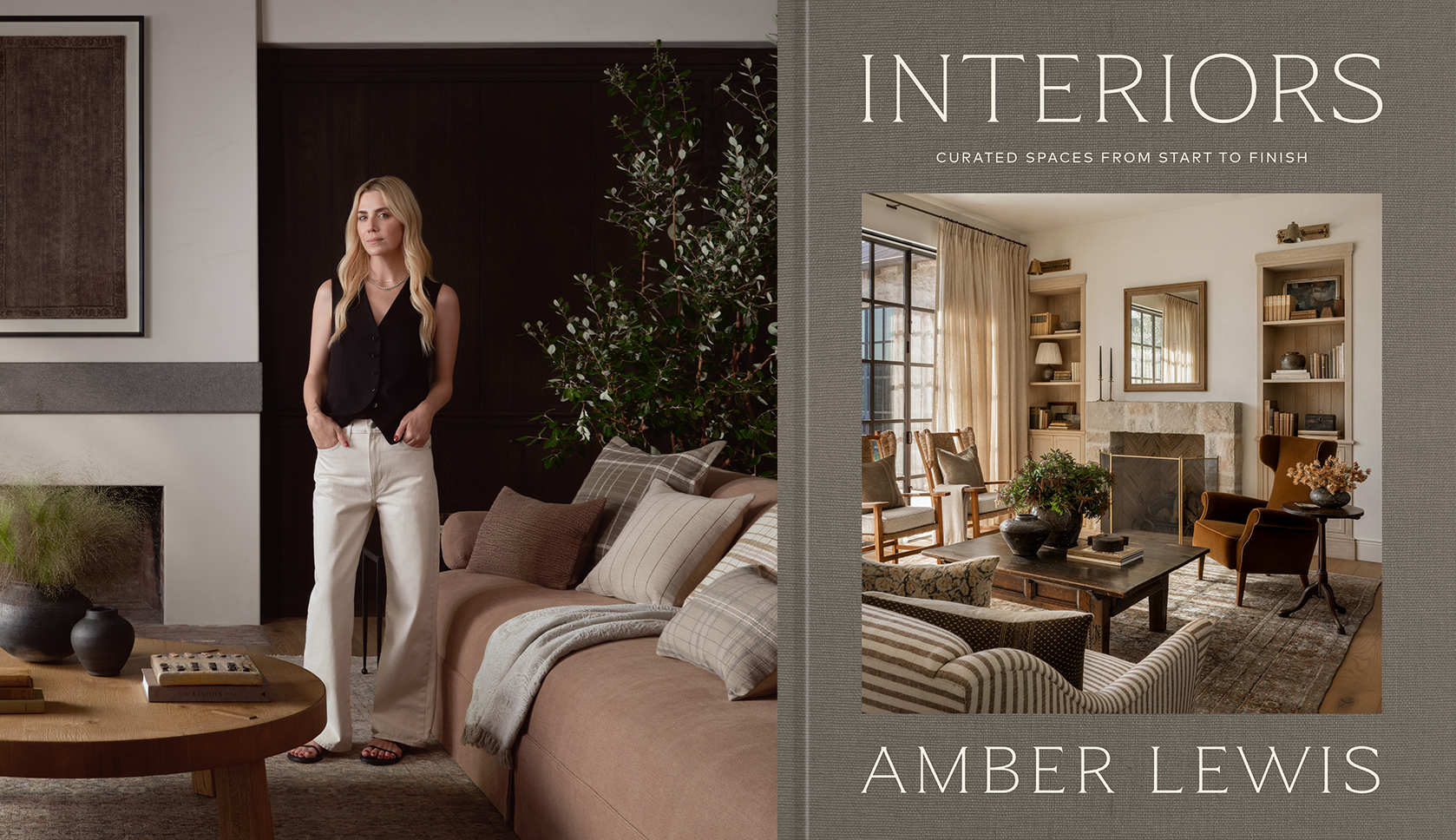

For Amber Lewis, great design has never been about arriving at the perfect finished room—it’s about everything that happens along the way. In her new book, Interiors: Curated Spaces from Start to Finish, launching today (September 29), the celebrated designer pulls back the curtain on that process, sharing nine projects through what she calls the “Six P’s”: Ponder, Play, Procure, Patience + Panic, Pull It Together, and Pride.
Beyond the beautiful rooms, Amber gets practical, sharing the instincts and lessons she’s honed over more than 15 years in the industry—from sourcing vintage pieces and curating art to choosing lighting and wallpaper.
Ahead of the book’s release, we caught up with Amber to talk about building her business without a traditional design education, the misconception behind her signature aesthetic, and why figuring it out as you go might be the best design lesson of all.
When did you first discover your love of interior design? What’s a common misconception about the success of the firm?
Honestly, I didn’t set out to be an interior designer. I actually didn’t even understand it was a real job for a long time. I was working retail in my early twenties and gravitated toward doing the displays instead of selling — I liked making a bed, styling a table, that kind of thing. Clients started asking if I’d come do their homes, and one thing led to another. I never went to design school. I learned by doing: painting walls, building a blog, teaching myself Photoshop at night. The whole thing kind of built itself while I wasn’t looking.
As for a misconception — I think people assume the firm’s success came from one big aesthetic breakthrough, like I found “the look” and rode it. The truth is it’s never been about one style moment. It’s been fifteen years of taste evolving, of real projects with real budgets and real problems, and a team that’s grown alongside all of it. What people see is the finished, pretty version. What actually built the business is a lot less glamorous than that.
Amber Interiors is now as much of a verb as a brand. What is the feeling you want your aesthetic to evoke?
I want people to walk into a space and feel like they can exhale. That’s really it. Not precious, not too polished — just calm and lived-in, like the house has a little history to it even if it’s brand new. I’ve always loved a neutral background with something unexpected layered on top — a worn vintage piece, an odd little texture. If a room feels relaxed but still interesting, I’ve done my job.
Tell us a bit about the book’s format. What can readers expect?
Interiors walks through nine full home projects, and I organized the whole thing around what I call the six P’s: Ponder, Play, Procure, Patience + Panic, Pull It Together, and Pride. It’s basically the emotional and practical arc of every project I’ve ever worked on, start to finish. Readers get the parts nobody usually shows — the mental work that happens before a single swatch is pulled, the moments things go sideways, the sourcing hunts — not just the glossy after photos. There are also source callouts throughout with the specific paint colors, fabrics, and finishes I keep coming back to, so it’s meant to be useful, not just pretty to look at.
Were there any pleasant surprises during the writing process? Any “a-ha” moments you’re most excited to share with readers?
Writing it forced me to actually articulate things I do on instinct, which was harder than I expected but also kind of clarifying. I realized how much of the job is invisible — I’m basically building the finished room in my head months before anyone else can see it, and I’d never had to put words to that part before. Getting to slow down and explain the “why” behind decisions, instead of just making them, was the real surprise.
What is one thing you think every room needs?
Something with a little age or history to it. A vintage piece, a worn texture, anything that doesn’t look like it came from a showroom yesterday. It doesn’t have to be a big statement, even one object with some soul in it keeps a room from feeling flat.
Why do you think home design is important or meaningful?
Home is where everything else in life gets absorbed — it’s where you land at the end of the day, good or bad. I’ve always believed a home should give you comfort and a little bit of inspiration at the same time. That’s not vanity, that’s just quality of life. Especially now, when home has to do so much — work, rest, everything — I think good design matters more than people give it credit for.
What has been the most rewarding part of your career thus far?
Getting to build something on my own terms, without outside investors, so I could stay in control of both the creative side and how the business actually runs. It hasn’t been the easy way, but I wouldn’t trade it. On a more personal level, I’m proud that the work has stayed mine — that even as the business has grown into a few different companies, the design is still the thing that gets me most excited.
The book is filled with advice and lessons learned. Is there one piece of advice you share that you wish you’d had when you were first starting out?
I wish someone had told me it was okay not to have it all figured out before starting. I learned almost everything on the job — I didn’t have formal training, so I was constantly playing catch-up on the technical side while leaning hard on instinct and people skills. It worked out, but I’d have saved myself some stress knowing that figuring it out as you go is a completely legitimate way to build a career.
What do you have planned next?
More of what I’m already doing, just deeper. The design firm stays the center of everything, and I want to keep growing the parts of the business where I’m actually hands-on in the creative decisions, not just lending a name to something. I don’t have a script for what’s five years out. I’ve never really planned that far ahead — I just follow what I’m excited about next.